Make Submision

All manuscripts submitted to Jurnal Redoks undergo an initial screening by the Editorial Board or the assigned Section Editor. The screening assesses the manuscript's compliance with the journal's Author Guidelines, relevance to the journal's focus and scope, originality, and overall suitability for publication.
Manuscripts that do not meet the journal's requirements or fall outside its scope may be rejected without proceeding to the peer review stage.
Manuscripts that pass the initial screening are sent to qualified peer reviewers with expertise relevant to the subject of the manuscript. The peer review process evaluates the scientific quality, originality, and contribution of the manuscript to the development of knowledge in chemical engineering, chemical processes, environmental studies, and related fields.
Reviewers assess manuscripts based on the following criteria:
Originality and scientific contribution.
Relevance to the journal's focus and scope.
Appropriateness and validity of the research methodology.
Accuracy of data analysis, results, and discussion.
Quality and relevance of references.
Clarity of writing and compliance with the journal's technical requirements.
Reviewers provide constructive comments and recommendations to assist the editor in determining the suitability of a manuscript for publication.
Jurnal Redoks is committed to maintaining an objective, fair, and confidential peer review process. Reviewers are expected to evaluate manuscripts independently and disclose any potential conflicts of interest that may affect their impartiality.
Manuscripts received for review must be treated as confidential documents. Reviewers must not disclose, distribute, or use unpublished information from submitted manuscripts for personal or professional advantage.
The journal maintains a reviewer list separately from the Editorial Team to distinguish the roles and responsibilities of reviewers and editors.
The editorial decision is made independently by the authorized editor or Editorial Board, taking into account the reviewers' recommendations, the manuscript's scientific quality, and the journal's publication standards.
The possible decisions are:
Accepted: The manuscript is accepted for publication.
Revision Required: The author must revise the manuscript in response to the editor's and reviewers' comments.
Rejected: The manuscript is not accepted for publication.
Reviewers provide recommendations, while the final decision remains the responsibility of the authorized editor or Editorial Board.
Authors whose manuscripts require revision must respond to the comments and recommendations provided by the editor and reviewers. Revised manuscripts must be submitted within the deadline specified by the editorial team.
Depending on the nature of the revisions, the revised manuscript may be returned to the reviewers for further assessment or evaluated by the editor. The editorial team may request additional revisions when necessary to ensure the manuscript meets the journal's academic and technical standards.
Jurnal Redoks establishes estimated processing times for each stage of manuscript handling. The processing stages include initial screening, editorial assessment, author revision, peer review, final editorial decision, layout preparation, author proofreading, and publication.
The duration of each stage depends on the journal's editorial procedures and the time required by authors, editors, and reviewers to complete their respective responsibilities.
Actual processing times may vary depending on the complexity of the manuscript, reviewer availability, the extent of revisions required, and the timeliness of author responses. The editorial team strives to process manuscripts efficiently while maintaining the quality and integrity of the peer review process.
Jurnal Redoks maintains editorial records documenting the manuscript evaluation and publication process. These records may include initial screening results, reviewer assignments, reviewer reports, author revisions, editorial correspondence, and final editorial decisions.
The documentation supports the transparency, accountability, and integrity of the journal's editorial process.
Jurnal Redoks is committed to maintaining publication ethics and research integrity throughout the editorial and peer review process. Authors, editors, and reviewers are expected to uphold academic integrity, avoid conflicts of interest, and contribute to a fair and responsible publication process.
The journal's editorial decisions are based on the scientific merit, originality, relevance, and quality of submitted manuscripts, rather than personal, institutional, or other non-academic considerations.
Manuscripts that receive final acceptance proceed to copyediting, layout preparation, and author proofreading, as applicable. The editorial team coordinates these stages to ensure that the final article meets the journal's publication standards.
Only manuscripts that have completed the required editorial procedures and received final approval are published in Jurnal Redoks.




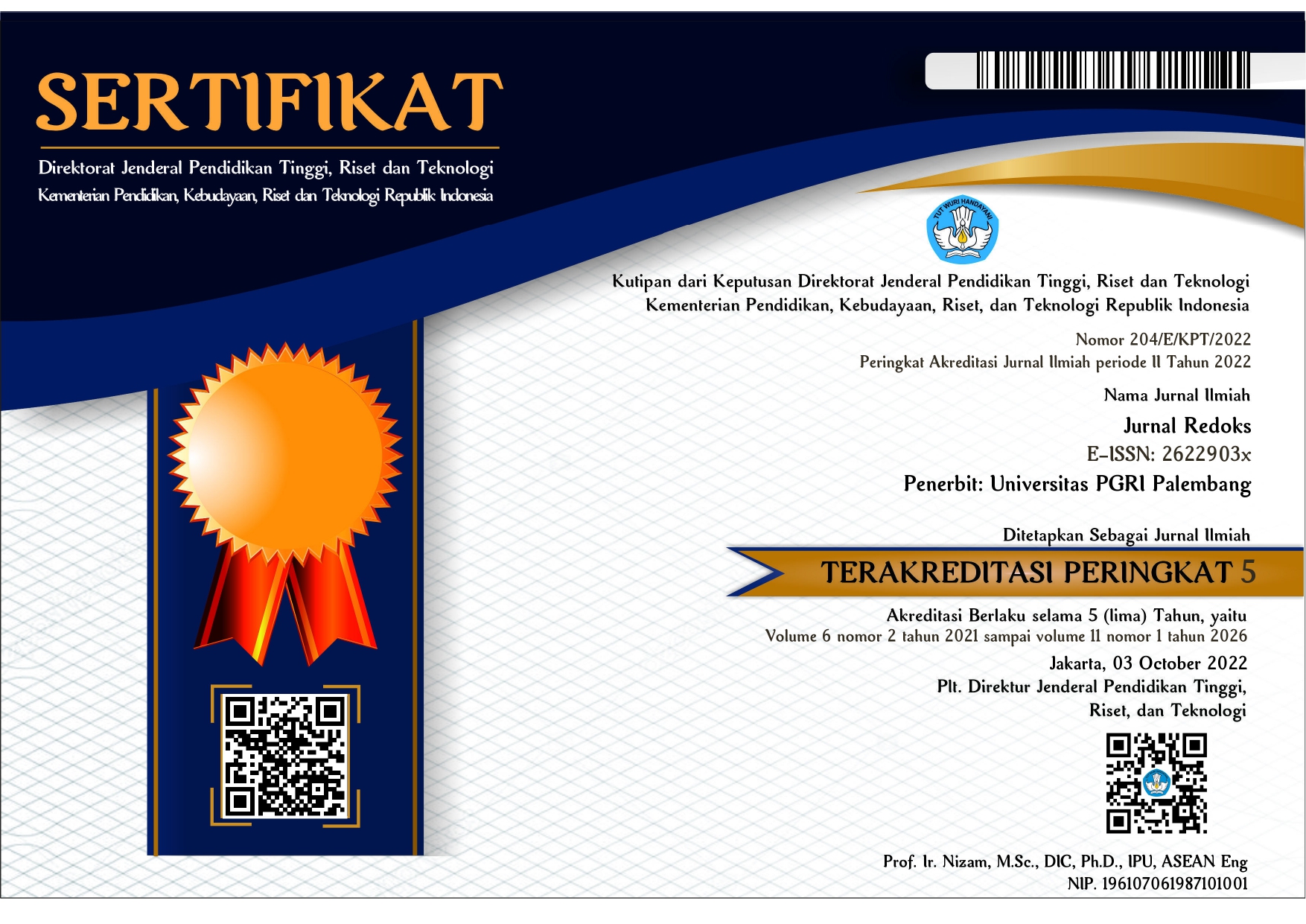
Published by
Universitas PGRI Palembang
 This work is licensed under a Creative Commons Attribution 4.0 International License (CC BY 4.0) .