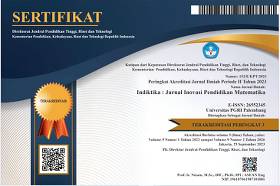
Accredited Rank 3 (SINTA 3)
Peer Review
Peer Review Process
Indiktika: Jurnal Inovasi Pendidikan Matematika applies a double-blind peer-review process to ensure the quality, originality, and scientific integrity of published articles. In this process, the identities of authors and reviewers are kept confidential. Each manuscript that passes the initial editorial screening is reviewed by at least two qualified reviewers with expertise relevant to the topic. The review process consists of the following steps.
1. Manuscript Submission
Authors submit their manuscripts through the journal’s online submission system using Open Journal Systems (OJS). Manuscripts must follow the journal’s author guidelines and use the required manuscript template.
2. Editor-in-Chief Assessment
The Editor-in-Chief checks whether the manuscript fits the journal’s focus and scope, follows the author guidelines, and meets the basic requirements for scientific quality. The editor also checks the completeness of the manuscript and its similarity to previously published works using plagiarism-detection software. Manuscripts that do not meet these requirements may be rejected or returned to the authors for correction.
3. Reviewer Selection and Invitation
Manuscripts that pass the initial screening are assigned to at least two reviewers with relevant academic expertise. Reviewers are selected based on their knowledge of the subject and the absence of conflicts of interest. The journal applies a double-blind review process, meaning that reviewers do not know the authors’ identities, and authors do not know the reviewers’ identities.
4. Reviewer Response
Invited reviewers consider whether the manuscript matches their expertise, whether they have any conflicts of interest, and whether they have sufficient time to complete the review. They may accept or decline the invitation.
5. Manuscript Review
Reviewers evaluate the manuscript’s originality, research methods, accuracy of analysis, clarity of presentation, validity of conclusions, relevance to mathematics education, and contribution to the field. Reviewers provide comments and recommendations to help the editor decide whether the manuscript should be accepted, revised, or rejected.
6. Evaluation of Review Reports
The editor considers the reviewers’ comments and recommendations before making a decision. If the reviews differ significantly, the editor may seek an additional review. The final decision is based on the quality of the manuscript, the reviewers’ assessments, and the journal’s publication standards.
7. Editorial Decision and Author Notification
The editor informs the corresponding author of the decision through the journal’s online system or email. The decision may be acceptance, minor revision, major revision, or rejection. Reviewer comments are provided anonymously to help authors understand the required revisions.
8. Revision and Final Decision
Authors must revise their manuscripts according to the reviewers’ and editor’s comments and submit the revised version within the specified deadline. The revised manuscript may be returned to the reviewers for further evaluation or assessed by the editor, depending on the extent of the revisions. The editor makes the final decision on acceptance or rejection. Accepted manuscripts proceed to copyediting, layout, and publication according to the journal’s editorial schedule.