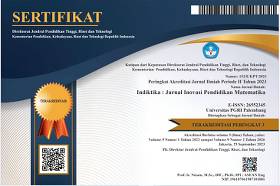
Accredited Rank 3 (SINTA 3)
Plagiarism, Correction and Retraction Policy
Plagiarism Policy
Jurnal Indiktika is committed to upholding the highest standards of academic integrity, originality, and ethical publishing. The journal takes plagiarism and other forms of research misconduct seriously and is committed to ensuring that all published articles meet established standards of scholarly ethics.
Plagiarism occurs when authors use another person's words, ideas, data, findings, or other intellectual contributions without appropriate acknowledgment or citation. Plagiarism includes, but is not limited to:
-
Directly copying text from other sources without proper quotation and citation.
-
Paraphrasing or rephrasing another person's work without appropriate acknowledgment.
-
Using ideas, data, figures, tables, or research findings from other sources without proper citation.
-
Presenting another person's work as one's own.
-
Reusing substantial portions of one's previously published work without proper acknowledgment (self-plagiarism).
Similarity Index
All manuscripts submitted to Jurnal Indiktika may be screened for similarity using plagiarism detection software, such as Turnitin. The journal applies a maximum similarity index of 20%, excluding properly identified references, quotations, and other legitimate matches where applicable.
The similarity index is used as an initial screening indicator and does not, by itself, determine whether plagiarism has occurred. Each similarity report will be evaluated by the editorial team to assess the nature, source, and context of the detected similarities.
Manuscripts that exceed the journal's similarity threshold or contain indications of plagiarism may be returned to the authors for clarification or revision, or rejected, depending on the severity of the findings and the journal's editorial judgment.
Plagiarism Screening Process
-
Initial Screening: Submitted manuscripts are screened for similarity before or during the editorial assessment process.
-
Similarity Assessment: The editorial team examines the similarity report, considering the sources matched, the extent of overlap, the accuracy of citations, and the originality of the manuscript.
-
Editorial Decision: Manuscripts that meet the journal's originality and ethical standards may proceed to peer review. Manuscripts with substantial or inappropriate similarities may be returned for revision or rejected.
-
Further Investigation: If potential plagiarism or other research misconduct is identified, the journal may request an explanation from the authors and conduct further assessment before making a decision.
Consequences of Plagiarism
If plagiarism is identified during submission, peer review, or after publication, Jurnal Indiktika will take appropriate action based on the seriousness of the case and the available evidence. Possible actions include:
-
Manuscript Rejection: A manuscript may be rejected if plagiarism is confirmed during the submission or review process.
-
Request for Correction: Authors may be asked to correct citation errors or other inappropriate similarities when the issue is minor and can be appropriately resolved.
-
Retraction: If serious plagiarism is confirmed after publication, the journal may retract the article in accordance with its retraction policy and publication ethics procedures.
-
Notification of Relevant Institutions: Where appropriate and justified, the journal may notify the authors' affiliated institutions or other relevant parties.
-
Author Notification: The corresponding author will be informed of the editorial decision and, where appropriate, provided with relevant evidence or a similarity report.
All allegations of plagiarism will be assessed fairly and confidentially. Authors will be given an opportunity to respond to allegations before a final decision is made, where appropriate.
Authors' Responsibilities
Authors submitting manuscripts to Jurnal Indiktika are responsible for ensuring the originality and integrity of their work. Authors must:
-
Submit original work that has not been published previously, except where prior publication or reuse is explicitly permitted and properly disclosed.
-
Cite all sources of ideas, statements, data, methods, figures, tables, and other materials taken from other works.
-
Use quotation marks and appropriate citations when reproducing text verbatim.
-
Paraphrase sources accurately and provide appropriate attribution.
-
Obtain permission for copyrighted material when required.
-
Disclose any substantial overlap with their previously published work.
-
Cooperate with the editorial team in addressing questions concerning originality and research integrity.
Correction
A correction may be issued when an error is identified in a published article that affects the accuracy, clarity, or completeness of the publication but does not invalidate its main findings or conclusions.
Requests for corrections may be submitted by authors, readers, reviewers, or other relevant parties. All requests will be assessed by the editorial team to determine the nature and significance of the error and the appropriate action.
Corrections may include, but are not limited to:
-
Errors in author names, affiliations, or other publication details.
-
Typographical, formatting, or factual errors that affect the interpretation or accuracy of the article.
-
Errors in tables, figures, references, or other published information.
-
Other inaccuracies that can be corrected without undermining the validity of the research findings.
When a correction is approved, Jurnal Indiktika will publish a correction notice describing the error and the changes made. The correction notice will be linked to the original article to ensure transparency and traceability. The original article will remain available, with appropriate links to the correction notice, unless further action is necessary.
Minor typographical errors that do not affect the meaning or interpretation of the article may be corrected without a separate formal correction notice, where appropriate.
Retraction
Indiktika: Jurnal Inovasi Pendidikan Matematika is committed to maintaining the accuracy and integrity of published research. A published article may be retracted if there is clear evidence of a serious problem that affects the reliability or integrity of the article.
An article may be retracted for the following reasons:
-
The research findings are unreliable because of data fabrication, data falsification, or serious errors in the research or analysis.
-
The article has been published elsewhere without proper acknowledgment or justification.
-
The article contains plagiarism or other serious violations of publication ethics.
-
The research was conducted or reported in an unethical manner.
-
Other serious ethical violations are found that affect the validity or integrity of the published article.
The editorial board will carefully review the evidence before making a decision to retract an article. Authors will be given the opportunity to explain the issues when appropriate.
If an article is retracted, the journal will publish a retraction notice explaining the reason for the retraction. The notice will be linked to the original article to ensure transparency and inform readers.
The retraction process will follow the relevant guidelines of the Committee on Publication Ethics (COPE), available at https://publicationethics.org.